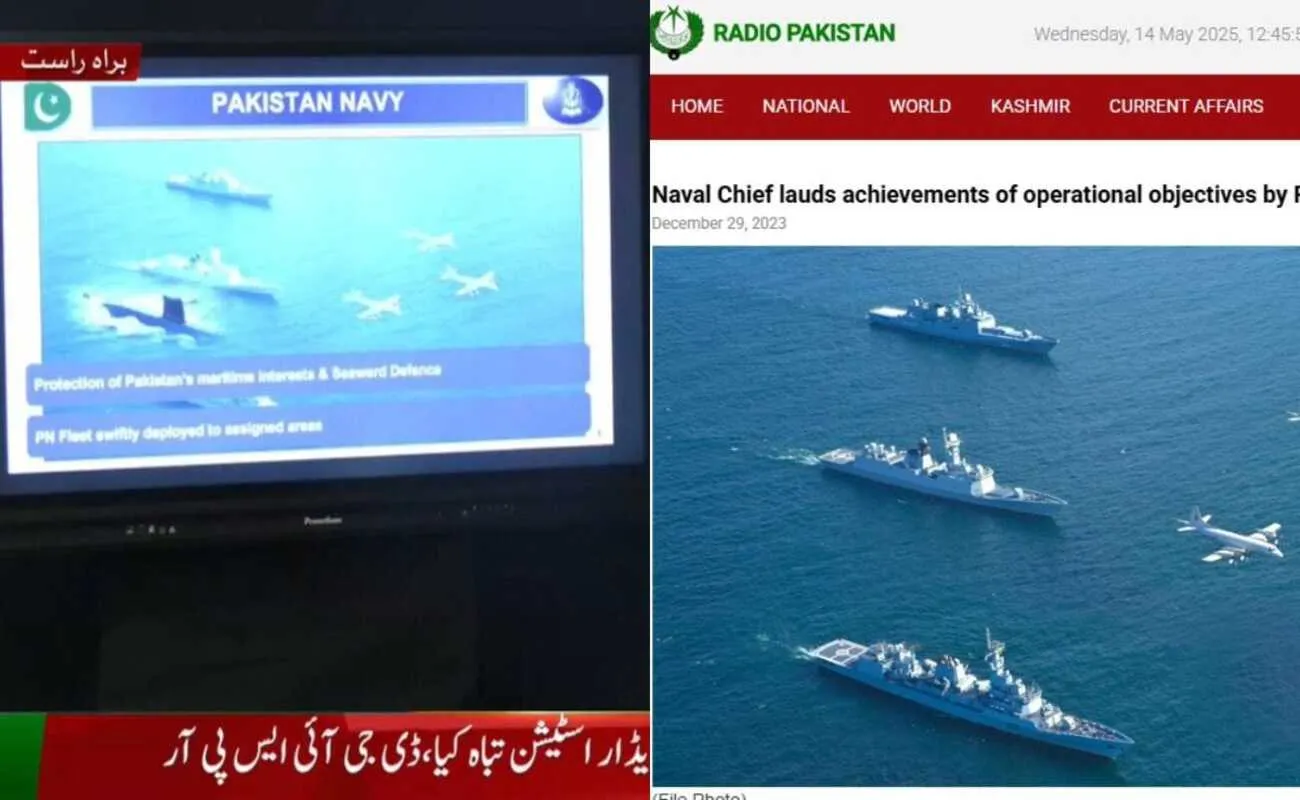
Pakistan Navy Uses Doctored Image to Show Operational Readiness
In a recent press briefing intended to project military preparedness, Pakistan’s armed forces have come under intense scrutiny after presenting an outdated and digitally manipulated image to support claims of naval operational readiness. The image, shown during an official press conference in Islamabad, was used to suggest heightened naval activity in response to increasing tensions with India but has now been revealed as an altered version of a photograph dating back to at least 2023.
The controversial image was unveiled during a joint briefing by senior Pakistani military officials, including Air Vice Marshal Aurangzeb Ahmed, Director General of Public Relations for the Pakistan Air Force, and Vice Admiral Raja Rab Nawaz, Deputy Chief of Naval Operations. The officials claimed that Pakistan’s air, land, and naval forces were at peak operational capacity and fully ready for deployment.
Central to their presentation was a dramatic photograph showing what appeared to be a well-coordinated naval exercise, featuring two warships, a submarine, and three maritime patrol aircraft. According to the officials, this image served as visual proof of active deployment by the Pakistan Navy in the Indian Ocean amid the current geopolitical strain.
However, independent analysts and open-source researchers quickly identified discrepancies. A reverse image search and archive verification traced the original photograph to a 2023 Radio Pakistan publication. The image was captured during a joint naval exercise between China and Pakistan held in the Indian Ocean. The original photograph included Chinese and Pakistani warships accompanied by three Lockheed Martin P-3C Orion maritime patrol aircraft but did not include the submarine shown in the new version.
The digitally inserted submarine—believed to be a Pakistani diesel-electric model—was not present in the original image. This suggests that the photo was intentionally altered to exaggerate the country’s maritime strength. The manipulated image was previously used in a 2023 article celebrating Pakistan Navy's operational achievements, particularly during the Fleet Annual Efficiency Competition Parade held in Karachi.
The revelation of image manipulation has triggered widespread criticism and raised serious concerns about the credibility of Pakistan's official military communications. In an environment already saturated with tension following the recent Pahalgam terrorist attack in India—which resulted in the death of 26 civilians—such misinformation threatens to further inflame public sentiment and destabilize diplomatic efforts.
India’s retaliatory measures following the Pahalgam incident have led to heightened military vigilance on both sides. In this context, Pakistan’s dissemination of altered visuals to suggest heightened readiness not only undermines its own credibility but also risks escalating an already fragile situation based on misleading narratives.
More troubling is that the disinformation campaign extended beyond official channels. Major Pakistani television networks and online media outlets aired the manipulated image without vetting its authenticity. Many segments repeated the narrative of superior naval preparedness, citing unnamed “official sources” and failing to provide independently verifiable evidence. This has contributed to a digital environment rife with misinformation, where truth and fiction are increasingly difficult to distinguish.
Analysts warn that the deliberate use of doctored imagery as a strategic communications tool is not just a matter of poor optics—it represents a deeper issue of trust and transparency within Pakistan’s defense establishment. In the age of real-time fact-checking and open-source intelligence, attempts to propagate false visuals can quickly backfire, exposing governments to global embarrassment and domestic skepticism.
International observers also point to the broader implications of such actions. For countries already under the microscope for human rights and governance issues, engaging in misinformation—especially in matters as sensitive as national defense—can damage diplomatic relationships and hinder efforts to build regional stability.
The use of manipulated media in statecraft is not new, but in the case of Pakistan, the timing and nature of this incident raise serious concerns. When national security narratives are built on altered visuals and unverifiable claims, it reflects a broader problem of narrative control over truth. It also highlights the growing role of visual media in military propaganda, especially in volatile regions like South Asia where tensions can quickly spiral out of control.
The incident also calls into question the role of Pakistan’s domestic media, which in many instances echoed the official narrative without independent verification. A healthy democracy requires a media landscape capable of questioning official accounts, not simply amplifying them.
As tensions continue to simmer between India and Pakistan, the need for clear, accurate, and verified information becomes more critical than ever. The revelation that Pakistan used a morphed image to assert military readiness should serve as a wake-up call—not just for Pakistani citizens, but for the international community watching closely. In times of geopolitical crisis, credibility is a nation's most valuable asset. Once lost, it is difficult to reclaim.
In conclusion, this episode is more than just a case of photo manipulation. It underscores the dangers of state-sponsored disinformation and the crucial need for accountability and transparency in defense communications. For Pakistan, the road ahead requires not only diplomatic restraint but also a firm commitment to truth—both in words and in images.