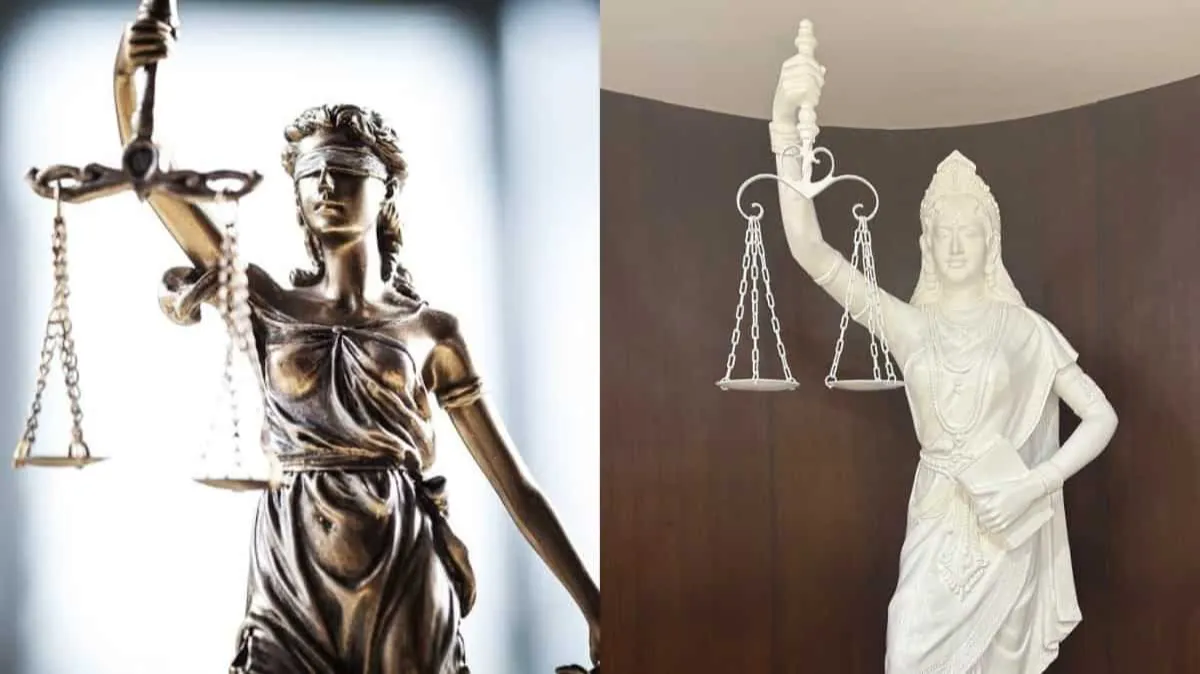
India’s Supreme Court Unveils a New Lady Justice Statue: Social Media Reacts
In a significant move, the Supreme Court of India recently unveiled a new Lady Justice statue in its library, sparking widespread reactions on social media. The updated figure, symbolizing a break from colonial past, no longer wears a blindfold and holds the Indian Constitution instead of a sword. The attire has also changed from Western robes to a traditional Indian saree. While some applauded the symbolism, others criticized it, suggesting the change could undermine the concept of impartial justice.
A Symbolic Break from Tradition
Historically, the Lady Justice figure is rooted in Greek and Roman mythology, where she represents balance, fairness, and the power of law. Traditionally, the blindfold signifies the impartiality of justice, while the scales and sword represent balance and authority. These elements were adapted into Indian judiciary under British rule, symbolizing equality before the law. However, the recent update reflects a modern interpretation, aiming to move away from colonial imagery.
The removal of the blindfold has led to heated debate. Supporters of the redesign argue it symbolizes transparency, implying that justice in India is not “blind” to social realities. Critics, however, feel that this change could be interpreted as compromising fairness, with some social media users voicing concerns that it reflects the ongoing delays and biases in the Indian judicial system.
Social Media Reactions: Mixed Views
Social media erupted with opinions, both positive and negative. One user humorously commented that Lady Justice “needs a watch,” pointing to the slow pace of the judiciary, while others expressed disappointment over what they perceive as mere “optical changes” that fail to address systemic issues in Indian courts. Some commentators defended the statue, stating that the blindfold's absence could represent a more informed, socially conscious legal system.
In response to the redesign, users offered various perspectives on what they believe the symbol should represent. Some emphasized that justice in India has long been perceived as partial, while others called for practical changes rather than symbolic ones, such as reducing court backlogs and ensuring timely judgments.
A Controversial Yet Meaningful Shift
The redesigned Lady Justice statue is part of a broader initiative to decolonize symbols within the Indian judiciary. While the new design has received mixed reactions, it undeniably reflects a deeper conversation about the evolving nature of justice in India. Whether this new representation will be embraced or continue to be debated remains to be seen, but it has certainly ignited discussions around the intersection of tradition, symbolism, and the law in India.
Conclusion
As India’s Supreme Court continues its journey to modernize and break away from its colonial past, the redesigned Lady Justice statue is a powerful statement. With social media users offering varied opinions, the statue's unveiling highlights the ongoing public discourse on the role of justice in contemporary India. Whether this transformation is symbolic or signals a deeper shift in judicial philosophy remains a key question.
Refrence From: www.wionews.com